
 |
| Transfăgărășan |
Day 6 - Brașov to Pitești via
Transfăgărășan (DN7C)–246 km.
or THE BEST ROAD IN THE WORLD

The most important reason we decided to visit Romania with motorcycle was because we wanted to pass through the two most famous roads of Romania, the first one is the Transalpina (DN67C) and the second one is the Transfăgărășan or DN7C.
According to Top Gear, the famous British TV show and its host Jeremy Clarkson, the Transfăgărășan is ‘the best road in the world’. It is is the second-highest paved road in the country after the Transalpina and it is crossing the southern section of the Carpathian Mountains.
 |
| Transfăgărășan is a road with steep hairpin turns, long S-curves, and sharp descents |
From Brașov to Arpașu de Jos it takes 95km on the road DN1 and from there you need to follow DN1 to the crossroad to DN7C. It stretches to 151km to Bascov, near Pitești, and between the highest peaks in the country, the Moldoveanu Peak and the Negoiu Peak at Făgărăș Mountains.
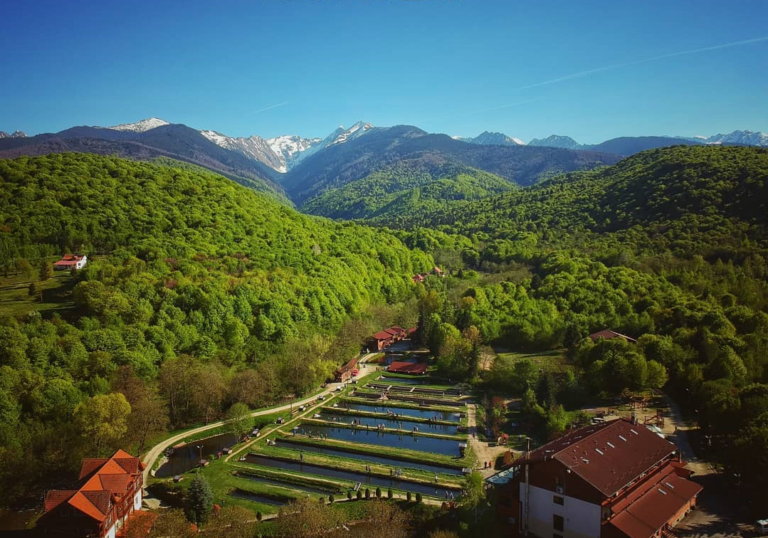 |
| Albota Trout Farm |
We had a coffee stop at the Albota Trout Farm, a farm with trout ponds, a hotel, a horse riding facility, a store which sells their home-made products, wooden cabins, restaurant and plenty of activities, an ideal place for family vacations near the nature.
The Transfăgărășan road was constructed between 1970 and 1974 during the rule of Nicolae Ceausescu. The Soviet Union invaded to Czechoslovakia in 1968 and Ceausescu was afraid of an invasion to Romania too, so he wanted to ensure quick military access across the mountains. There were other passes mainly through river valleys, the DN1, the DN67C, the DN66, it could be easy for the Soviets to block and attack these passes, and for this reason he wanted a road across the mountains.

| |
The road built mainly by military forces, and had a high financial and human cost, it is known that officially 40 soldiers lost their lives, but unofficially the dead workers were hundreds.
The road climbs to an altitude of 2,042 m, the second highest mountain pass in Romania. It is a winding road, with steep hairpin turns, long S-curves, and sharp descents.
 |
| Treeless alpine scenery at Transfăgărășan road with steep hairpin turns |
It is an attraction for motorcycle riders, hikers, cyclists, and drivers because it is challenging and can be a difficult task. The average speed is around 40 km/h ant the road also provides a access to the beautiful Bâlea Lake and Bâlea Waterfall. There is a cable car which connects the lake with the waterfall with scheduled trips and a ticket, the length of the route is 3700m, the minimum altitude is 1200m, and the maximum altitude is 2040m.
 |
| Capra Waterfall |
The road is usually closed from late October until late June because of snow. We were lucky because the weather was warm at the time we visited Romania so it remained open. There are signs at the town of Curtea de Arges and the village of Cartisoara to provide information.
 |
| Young bear searching for food |
Because of the good weather we had cute company during to our trip, we met many bears, mostly young ones which were searching for food and they were very friendly to the people.
 |
| The young bears were very friendly to the people |
The Transfăgărășan has 5 tunnels and specific kind of bridges, they are called viaducts, with a series of arches and columns to support the road. The Bâlea Tunnel, the longest road tunnel in Romania with 884 m, is near the highest point where Bâlea Lake is.
 |
| Tunnels near Balea Lake |
In the middle of the road is Vidraru Lake with Vidraru Dam, a very touristic area with hotels and restaurants.
 |
| Vidraru Dam |
 |
| Vidraru Dam |
Along the southern section of the road, near the village of Arefu, is Poenari Castle, the residence of Vlad Tepes (Vlad The Impaler). It is said that he was the inspiration figure for Bram Stoker's ‘Count Dracula’ although the writer never confirmed that Tepes was his inspiration and he himself never visited Romania. The castle that Stoker used in his novel was Castle Bran, the only castle in the region that remains intact.
 |
| Restaurant la Cetate |
We had our next coffee stop at Restaurant la Cetate, a place that looks like a museum with traditional decoration and near the Poenari Castle.
 |
| Restaurant la Cetate |
The northern section of the road is used for annual cycling competitions, including The Tour of Romania, and the 22 km section to Bâlea Lake has been used since 2011 for the Sibiu Cycling Tour, both sections are considered to be similar in difficulty Hors catégorie (HC) to the Tour de France.
 |
| Strand Park at Pitesti |
We reached Pitesti at evening so we had only a short time to explore the city. We visited the Strand Park, a park near to our hotel and after our dinner we returned back for resting because next day we had a long trip to Veliko Tarnovo at Bulgaria. Continue your reading!
Day 7 - Pitesti - Veliko Tarnovo

No comments:
Post a Comment